Analysis
Digital arrest scams in India: complaints fall, but the Supreme Court and CBI keep up pressure
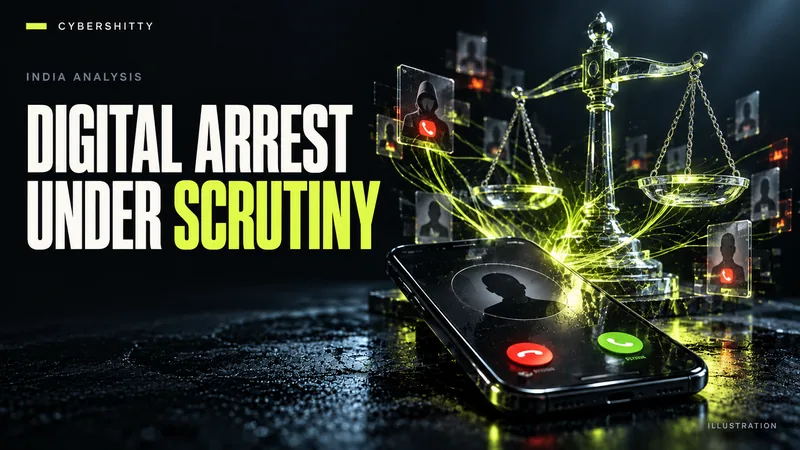
AI-generated editorial illustration by CyberShitty. Not a photograph or a document from the organisations named.
Official data put to the Supreme Court show digital arrest complaints on the national portal falling since 2024. The court has ordered new safeguards on mule accounts, the CBI is raiding networks and the Centre is pressing WhatsApp.
01 / What the latest numbers say
In a "digital arrest" scam, callers pose as police, CBI, customs, telecom or court officials. They tell the victim on a video call that they are under investigation and keep them "under arrest" online, sometimes for weeks, until they transfer money. Recent official figures suggest the scam is being reported less often, though it has not gone away.
According to a status report from the Indian Cyber Crime Coordination Centre (I4C), cited in the Supreme Court's order of 4 August 2026, complaints about digital arrest on the National Cyber Crime Reporting Portal (NCRP) fell from 1,23,672 in 2024 to 58,249 in 2025, and stood at 16,377 up to 30 June 2026, as reported by IANS. The bench said the amounts reported lost had also fallen substantially, but that monitoring still had to continue.
Other official data put the problem in a different light. Ministry of Home Affairs (MHA) data reported by ThePrint in February 2026 put digital arrest at 6% of all cybercrime cases and 9% of all money lost in 2025, a year in which reported losses totalled ₹22,495 crore. Six per cent of the 28.15 lakh cases that year would be far more than 58,249. The two sets of figures probably count different things, and neither source explains how. Treat each one as a measure of its own dataset only.
02 / The Supreme Court's suo motu case
The court took up the issue on its own motion in 2025 (SMW (Crl.) 3/2025, In Re: Victims of Digital Arrest Related to Forged Documents) after a senior-citizen couple wrote in to say they had been defrauded. A bench headed by Chief Justice Surya Kant has issued interim directions several times since, and has directed the CBI to act against the networks behind these scams.
The order of 4 August 2026, as reported by LiveLaw and IANS, directs that:
- The RBI adopt, within four weeks, a standard operating procedure for banks to place temporary debit holds on suspected mule accounts, and run grievance-redressal and money-restoration mechanisms.
- States and Union Territories notify and run State Cyber Crime Coordination Centres within four weeks, and adopt the e-Zero FIR mechanism in consultation with I4C.
- An inter-departmental committee examine a framework for shared liability and victim compensation, and a proposal to lower the loss threshold above which the CBI takes up cases.
The same report records ₹18.05 crore restored in 36,290 cases through the new money-restoration module, with 57 banks taking part. The MHA says that module and the grievance module went live in April 2026. On 28 July 2026 the bench also suggested that the Centre make digital arrest a separate offence with harsher punishment, Bar & Bench reported. The matter was listed again for 16 September 2026, with a fresh consolidated status report due.
Fewer complaints is progress. A scam that still costs single victims crores of rupees has not been beaten.
03 / Enforcement and platform pressure
- CBI: Under Operation Chakra-VI, the agency said on 27 September 2026 that it had searched 142 locations in 22 states over the past 30 days in four digital arrest cases, and arrested 17 people (ETV Bharat). In February 2026, LiveLaw reported that the CBI was using I4C data to pick out cases with losses of ₹10 crore or more.
- Telecom blocking: As of 30 June 2026, more than 15.75 lakh SIM cards and 5.77 lakh IMEIs reported by police had been blocked, the MHA told the Lok Sabha on 28 July 2026. These figures cover all cybercrime, not only digital arrest.
- WhatsApp: In March 2026, an MHA inter-departmental committee asked WhatsApp to block device IDs used in scams, detect malicious APK files and flag misuse of police and CBI logos, National Herald reported. The Department of Telecommunications (DoT) separately requires messaging apps to bind accounts to an active SIM.
04 / Confirmed vs. claimed
Confirmed: the complaint trend, restoration figures and directions in the 4 August order; the MHA's SIM and IMEI blocking totals; the CBI's statements on searches and arrests. Claimed / unconfirmed: the WhatsApp commitments come from unnamed officials, and neither the MHA nor Meta commented on them. We could not confirm what happened at the 16 September hearing. How the digital arrest counts relate to the wider category shares in MHA data is not explained anywhere.
05 / What to do now
- There is no such thing as a "digital arrest". No real officer will keep you on a video call or ask you to move money to "verify" it. Hang up, and tell a family member.
- If you have paid, call 1930 at once and file a complaint at cybercrime.gov.in. The faster you report, the better the chance that the money is put on hold.
- Report the number or WhatsApp account via Chakshu on Sancharsaathi.gov.in or the Sanchar Saathi app.
- If a bank has frozen your account over a complaint, use the NCRP grievance route that the Supreme Court has asked states to publicise.
- Talk to older relatives. Senior citizens have lost some of the largest single amounts.
Source log / 2026-0929-DA
- LiveLaw — Digital Arrest Scams: Supreme Court issues directions for prevention, compensation and grievance redressal (4 August 2026) Secondary
- IANS — SC issues fresh directions to strengthen fight against digital arrest scams (4 August 2026) Secondary
- LiveLaw — Digital Arrests: MHA proposes SOP before Supreme Court (10 February 2026) Secondary
- Bar & Bench — Supreme Court calls for separate offence on digital arrests (28 July 2026) Secondary
- PIB (MHA) — Cyber Crime Mitigation Centre, Lok Sabha reply (28 July 2026) Primary
- ThePrint — Cybercrime saw 24% spike in 2025; Indians lost Rs 22,495 crore (21 February 2026) Secondary
- National Herald — Govt asks WhatsApp to tighten safeguards against 'digital arrest' scams (21 March 2026) Secondary
- ETV Bharat — Two more held by CBI in Rs 11.42 crore digital arrest case (27 September 2026) Secondary