Guide
Digital arrest scam: how to recognise the call, what to do on it, and what to do if you paid
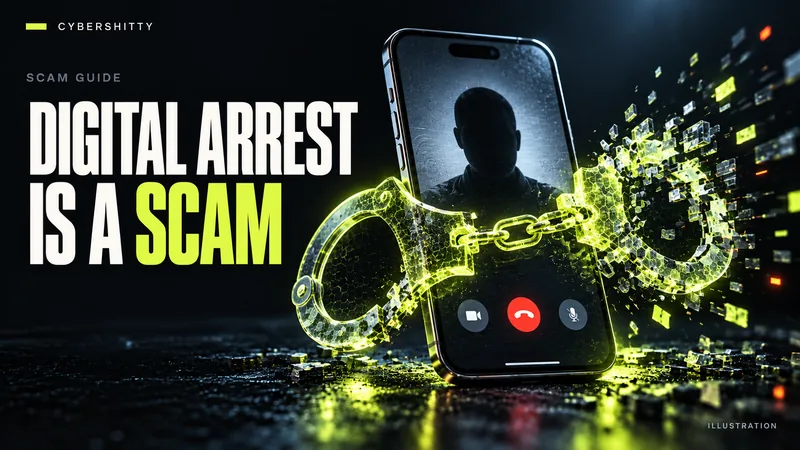
AI-generated editorial illustration by CyberShitty. Not a photograph or a document from the organisations named.
No Indian agency questions or arrests anyone over a video call. Here is how the fake CBI, police and TRAI script works, how to leave the call safely, and where to report it: 1930, cybercrime.gov.in and Sanchar Saathi's Chakshu.
01 / What a digital arrest scam is
There is no such thing as a real digital arrest. The phrase describes an extortion scam. Criminals pretending to be the police, CBI, Narcotics, Enforcement Directorate, RBI or TRAI convince you that you are under investigation. They then keep you on a video call, sometimes for hours, until you transfer money to clear your name. The Home Ministry says the scam is an organised online economic crime run by cross-border syndicates, and that victims around the country have lost large sums.
If someone in uniform tells you to stay on a video call until you pay, that is the scam, not an investigation.
02 / The script: how the call usually goes
The Home Ministry and TRAI describe the same pattern:
- The hook: a parcel sent by you or addressed to you supposedly contains drugs, fake passports or other contraband. Or you are told a relative has been arrested or caught in an accident.
- The threat: impersonators of TRAI or the police accuse you of telecom or financial violations and threaten to arrest you, freeze your accounts or cut off your mobile number.
- The stagecraft: the caller moves you to Skype, WhatsApp or another video app. Fraudsters use sets made to look like police stations and government offices, wear uniforms, and show forged documents and IDs.
- The isolation: you are told to stay in view on camera until the matter is settled.
- The demand: money for bail, a fine or verification.
The number on your screen proves nothing. The government says criminals have used international calls spoofed to display Indian mobile numbers in these scams, and has told telecom operators to block such calls.
03 / What the government says
- In Mann Ki Baat on 27 October 2024, the Prime Minister reminded people that no government agency conducts investigations over phone or video calls. He urged them to stop, think and act, and to report to 1930 or cybercrime.gov.in.
- TRAI said in August 2025 that no regulatory body conducts investigations or collects payments through phone calls, messaging apps or video platforms. It added that it does not contact customers about disconnecting their numbers.
- The Home Ministry's May 2024 alert tells anyone who gets such a call to report it immediately to 1930 or cybercrime.gov.in. By March 2025, I4C had blocked more than 3,962 Skype IDs and 83,668 WhatsApp accounts used for digital arrest scams.
04 / If you are on such a call right now
- Disconnect. TRAI's advice is to hang up immediately on threatening or suspicious calls. You do not need anyone's permission to end a call.
- Do not share Aadhaar, PAN, bank details, OTPs or screenshots of your accounts, on a call or a video chat.
- Do not pay or move money to any account, even a "safe" or "verification" account, and do not install any app they tell you to.
- Verify on your own. Look up your local police station or the agency's number on its official website and call it yourself. Never use a number or link the caller gives you.
- Tell someone. Talk to a family member or friend. The scam depends on keeping you alone and frightened.
- Report it to 1930 or cybercrime.gov.in, even if you did not pay.
05 / If you have already paid
Call 1930 at once. The government says the helpline helps victims of online financial fraud by speeding up reporting and, where possible, freezing fraudulent transactions, so the sooner you call, the better. Then:
- File a complaint under Financial Fraud on cybercrime.gov.in and note the acknowledgement number.
- Report every transfer to your bank in writing, with the transaction IDs. Our UPI fraud guide explains RBI's reporting deadlines.
- Keep evidence: phone numbers, video-call IDs, screenshots of fake documents and uniforms, chat logs and payment receipts.
- Be wary of anyone who later contacts you offering to recover the money for a fee.
06 / Report the numbers on Sanchar Saathi's Chakshu
The Department of Telecommunications' Chakshu service, on the Sanchar Saathi portal and app, lets you report suspected fraud calls, SMS and WhatsApp messages, including impersonation of government officials. You can also report suspicious links. Report within 30 days: the portal says complaints made within that window are investigated. Chakshu is for reporting the communication only. If you have lost money, the portal itself says to report to 1930 or cybercrime.gov.in. TRAI also suggests flagging numbers through Chakshu or the TRAI DND app.
07 / Your checklist
- Remember that no agency investigates or arrests anyone over a video call.
- Hang up; don't share details, pay or install anything.
- Verify through official websites and numbers you look up yourself.
- Tell a family member.
- If you paid, call 1930, file on cybercrime.gov.in and tell your bank.
- Report the number or link on Chakshu within 30 days.
- Warn older relatives: TRAI says senior citizens need to stay especially alert.
Source log / 2026-0929-GD
- PIB (MHA) — Alert against incidents of 'Blackmail' and 'Digital Arrest' by cyber criminals impersonating Police, NCB, CBI, RBI and other agencies (14 May 2024) Primary
- PIB (MHA) — Mann Ki Baat: PM warns against 'Digital Arrest' fraud (27 Oct 2024) Primary
- PIB (TRAI) — TRAI issues advisory on fraudulent activities misusing TRAI's name (6 Aug 2025) Primary
- PIB (MHA) — Steps taken to address the issue of digital arrest scams, Lok Sabha reply (12 Mar 2025) Primary
- Sanchar Saathi (DoT) — Chakshu: report suspected fraud communication Primary
- PIB — Curbing Cyber Frauds in Digital India (8 Oct 2025) Primary