Guide
Loan taken in your name? How to check loans on your PAN, dispute them and claim ₹100 a day
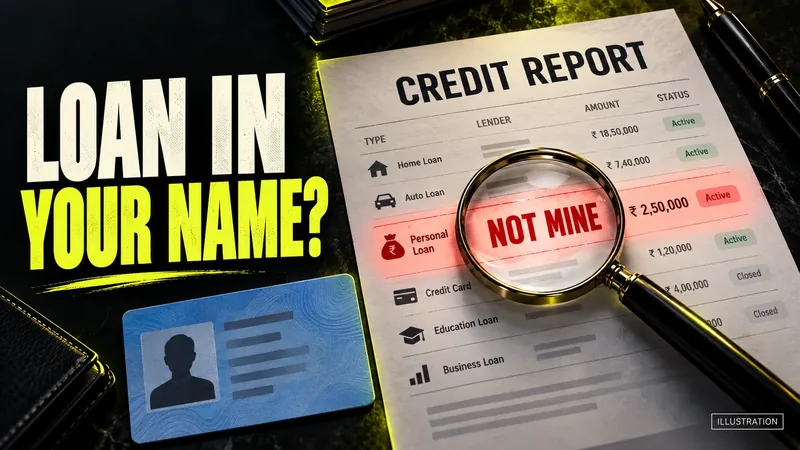
AI-generated editorial illustration by CyberShitty. Not a photograph or a document from the organisations named.
A loan taken with your PAN should show up in your credit report, and RBI gives you one free report a year from each bureau. How to check, how to dispute a loan you never took, and how RBI's ₹100-a-day compensation for delay works.
01 / The short answer
A loan or credit card taken in your name with your PAN should show up in your credit report. RBI requires each credit bureau to give you one free full credit report, with your score, every calendar year. You do not need to pay anyone, or install a 'PAN loan check' app, to look.
If you find a loan you did not take, complain in writing to the credit bureau and to the lender. Under RBI's rules, the two together have 30 calendar days to resolve your complaint. After that, you are owed ₹100 for every extra day. On 4 September 2026 RBI announced penalties on three credit bureaus for not paying this compensation on time.
The ₹100 a day pays for delay, not for the fraud, so file early and keep the date.
This guide goes further than the short credit-report section in our Aadhaar and PAN leak guide: how to check, how to dispute, how the compensation works and where to escalate.
02 / How loans end up in your name
A PAN is often only one piece. A case reported in July 2026 shows the others: Aadhaar details, a phone number the victim no longer controlled, and bank accounts to receive the money.
- Delhi: a resident complained to police on 25 June after a recovery agent began demanding EMIs for a ₹4.5 lakh personal loan he had never taken, The Pioneer reported, citing Delhi Police. He found that the loan had been taken with his PAN details, and that the mobile number linked to his Aadhaar had been changed without his knowledge. Police said documents of about 50 people had been misused to take loans worth about ₹1.6 crore from private non-banking financial companies, and the arrested man allegedly told them the loan money was routed into bank accounts whose owners let them be used for a commission. We found one report of this case, so we treat it as reported, not confirmed.
A new loan may not appear in your report at once. Since 1 January 2025, RBI has required lenders and credit bureaus to update credit information every fortnight (as on the 15th and the last day of each month) or more often if they agree. Lenders have seven calendar days after each fortnight to send the data, and bureaus five calendar days to load it. A report that is clean today may not yet show a loan taken last week.
03 / Signs to watch for
- A bureau alert you did not expect. RBI requires credit bureaus to send an SMS or email when a lender or other authorised user pulls your credit report and the enquiry shows up in it, wherever they have your mobile number or email address. An alert for an application you did not make is often the earliest warning you will get.
- A default or overdue alert from a lender you never borrowed from. RBI requires lenders to alert customers by SMS or email when they report a default or overdue payment to a bureau, wherever they have contact details.
- Recovery calls or EMI demands for a loan you never took, as in the Delhi case.
- A loan or card application turned down because of borrowing you do not recognise.
Alerts go to whatever number or email the bureau or lender holds. If a fraudster gave their own number, you may get no alert at all, which is why the yearly reports matter.
Recovery calls can also be a scam in themselves. Do not pay anything to 'close' a loan you never took. Ask the caller for the lender's name and the loan account number, then check them yourself in your credit report and with the lender on its official contact details. If calls turn abusive, see what to do about loan-app harassment.
04 / Check every bureau, free
RBI's 2015 directive named four credit bureaus registered with it: Credit Information Bureau (India) Limited, now TransUnion CIBIL; Equifax; Experian; and CRIF High Mark. It required all credit institutions, RBI's term for the banks and other lenders that report credit data, to become members of all of them.
- One free full report a year from each. Since 1 January 2017, each bureau must give you, on request and after checking your identity, one free full credit report with your credit score in each calendar year (January to December). It must be electronic and contain the same details as the most detailed version of your report that lenders see.
- On the bureau's own website. RBI's October 2023 directions require each bureau to show the link to the free report prominently on its home page. Type the bureau's address yourself. Do not enter your PAN on a site or app that reached you through an ad, SMS or WhatsApp link.
- Check all four. Each bureau keeps its own records, and RBI has told bureaus to review, at least every six months, the logic they use to match records to a person. Checking all four costs nothing and covers you if one bureau's records differ from another's.
- Our suggestion: rather than downloading all four reports on the same day, spread them across the year, roughly one every three months, so you look at a fresh report more often.
In each report, look for loans or cards you do not recognise, enquiries from lenders you did not approach, and addresses, phone numbers or email addresses that are not yours.
05 / Found a loan you did not take: what to do
- Save the evidence. Download the report as a PDF and note the lender's name, the account type, the date opened and the amount.
- Dispute it with the bureau in writing, through the dispute or complaint process on its own website, and keep the complaint number and date. RBI says that where wrong entries come from more than one lender, you should complain to the bureau, which must coordinate with every lender involved. If the loan appears in more than one bureau's report, raise it with each.
- Write to the lender, through its official grievance channel. Say you did not apply for the loan, ask it to investigate and to correct what it reports to the bureaus, and ask what documents, phone number and bank account were used. Keep its complaint number.
- Give your bank account or UPI ID in the complaint form. RBI requires lenders and bureaus to ask for these so that compensation can be paid. Getting them right is your responsibility.
- Report the identity theft. File a complaint on cybercrime.gov.in, choosing the category that fits best, or at your police station, and keep the acknowledgement. Add its number to your bureau and lender complaints. If money has also left your own bank account, call 1930 first. How to report.
- Close the gap that let it happen. Check your Aadhaar authentication history and make sure the mobile number linked to your Aadhaar is still yours: in the Delhi case it had been changed. How to lock and check.
06 / How the ₹100 a day works
RBI's compensation framework of 26 October 2023 took effect six months after it was issued. It covers complaints about credit information that is not corrected or updated in time.
- The clock. If your complaint is not resolved within 30 calendar days of the day you first filed it with the lender or the bureau, you are entitled to ₹100 for each calendar day of delay.
- Who pays. The lender gets 21 days to send corrected information to the bureaus, which leaves the bureau effectively nine. The lender pays if it misses its 21 days; the bureau pays if the lender met its deadline but the bureau did not resolve the complaint within 30 days. Where more than one of them caused the delay, RBI says the amount is shared between them in proportion.
- When it counts as resolved. On the day the corrected credit report is sent to your postal address or email. The compensation must reach your bank account within five working days after that.
- If they say no. You must be told what action was taken in every case, and given reasons if your request is rejected.
- What it does not cover. Disputes about how your credit score is calculated; complaints already decided by or pending before a consumer commission, court or tribunal; and disputes that the law sends to conciliation or arbitration.
The money is for delay. RBI's text does not mention identity theft or fraudulent loans, and it does not say what happens when a lender insists that a disputed loan is genuine. It does require written reasons for any rejection. Those reasons, and your police or cybercrime complaint, are what you take to the next step.
RBI has enforced it. On 4 September 2026, RBI announced penalties, by orders dated 31 August 2026, on TransUnion CIBIL (₹26,82,800), CRIF High Mark (₹6,89,600) and Equifax (₹1,19,400), a total of ₹34,91,800. In each case RBI found that the bureau had failed to credit compensation to the bank accounts of certain eligible complainants within the prescribed period. The findings came from inspections with reference to each company's financial position on 31 March 2025. The releases do not say how many people were paid late or how much they were owed. So count the days yourself, and if you are not paid in time, escalate.
07 / If the bureau or lender does not fix it
The 2023 rules say you can go to the RBI Ombudsman if a lender or bureau wrongly denies you compensation. The Ombudsman scheme in force since 1 July 2026, RB-IOS 2026, replaced the 2021 scheme, and RBI's FAQ lists credit bureaus among the entities it covers, along with banks and certain NBFCs.
- Complain to the bureau or lender first, and keep proof. You can go to the Ombudsman if you get no reply within 30 days, or sooner if you get a reply you are not satisfied with.
- File within 90 days of that deadline or of the last reply, whichever is later, at cms.rbi.org.in, by email to crpc@rbi.org.in, or by post. Filing is free, and RBI says you need not go through any agent or pay anyone. RBI's contact centre on 14448 can guide you and give you the status, but cannot take the complaint.
- A police complaint does not block you. RBI's FAQ says a police investigation into a criminal offence is not treated as the same grievance, so you can pursue both.
- Lender not covered? Not every NBFC falls under the scheme; housing finance companies, for one, are excluded. If a lender outside the scheme wrongly denies you compensation, the 2023 rules point to the Consumer Education and Protection Cells at RBI's regional offices.
How to file with the RBI Ombudsman, step by step.
08 / What we confirmed, and what we could not
Confirmed (RBI documents): the free yearly report from each bureau (2016 directions); the enquiry and default alerts and the home-page link to the free report (October 2023 directions); the ₹100-a-day framework, its deadlines and exclusions (October 2023 framework); the four registered bureaus and the rule that lenders join all of them (2015 directive), and CIBIL's change of name to TransUnion CIBIL (RBI, 2016); fortnightly reporting since 1 January 2025 (RBI, August 2024); the three penalties and their reasons (RBI press releases, 4 September 2026); and how RB-IOS 2026 works and whom it covers (RBI FAQ). Reported (media): the Delhi case of about 50 people's documents used for loans of about ₹1.6 crore (The Pioneer, citing Delhi Police; one report only). Our suggestion, not a rule: spreading the four free reports across the year. Not available: an official count of loans taken in other people's names. Not checked: RBI has issued consolidated Credit Information Companies Directions, 2025, last updated on 1 July 2026. Its PDF could not be retrieved for this guide, so we cite the original circulars; RBI's September 2026 penalty announcements still refer to the compensation framework by name.
09 / What to do now
- Not sure if anything is wrong: download your free report from each bureau's own website, then keep doing it through the year. Never through an app or link sent to you.
- Found a loan you did not take: complain in writing to the bureau and the lender today, add your bank account or UPI ID for compensation, and file on cybercrime.gov.in. How to report.
- Your PAN or Aadhaar may have leaked: lock your biometrics, check your authentication history and share less. What to do after an Aadhaar or PAN leak.
- Recovery agents calling about a loan you never took: do not pay; get the lender's name and loan account number and check them yourself. If you are being harassed.
- No fix or no compensation after 30 days: go to the RBI Ombudsman, with your complaint numbers and dates.
Source log / 2026-1003-JX
- RBI — Framework for compensation to customers for delayed updation/rectification of credit information, RBI/2023-24/72 (26 Oct 2023) Primary
- RBI — Strengthening of customer service rendered by Credit Information Companies and Credit Institutions, RBI/2023-24/73 (26 Oct 2023) Primary
- RBI — Free Annual Credit Report to Individuals, RBI/2016-17/58 (1 Sep 2016) Primary
- RBI — Membership of Credit Information Companies (CICs), RBI/2014-2015/405 (15 Jan 2015) Primary
- RBI — Frequency of reporting of credit information by Credit Institutions to Credit Information Companies, RBI/2024-25/60 (8 Aug 2024; in force 1 Jan 2025) Primary
- RBI — Grant of Certificate of Registration: TransUnion CIBIL Limited (change of name from Credit Information Bureau (India) Limited), RBI/2016-17/69 (29 Sep 2016) Primary
- RBI — RBI imposes monetary penalty on TransUnion CIBIL Limited, press release 2026-2027/1042 (4 Sep 2026) Primary
- RBI — RBI imposes monetary penalty on CRIF High Mark Credit Information Services Private Limited, press release 2026-2027/1043 (4 Sep 2026) Primary
- RBI — RBI imposes monetary penalty on Equifax Credit Information Services Private Limited, press release 2026-2027/1045 (4 Sep 2026) Primary
- RBI — Frequently Asked Questions: Reserve Bank - Integrated Ombudsman Scheme, 2026 (in force 1 Jul 2026) Primary
- RBI — Reserve Bank of India (Credit Information Companies) Directions, 2025 (updated as on 1 Jul 2026; PDF not reviewed for this guide) Primary
- The Pioneer — Man held in Rs 1.6 crore loan fraud racket (12 Jul 2026) Secondary
- National Cyber Crime Reporting Portal Primary