News briefing
ED arrests advocate it says bribed officials to unfreeze about 100 fraud-linked bank accounts
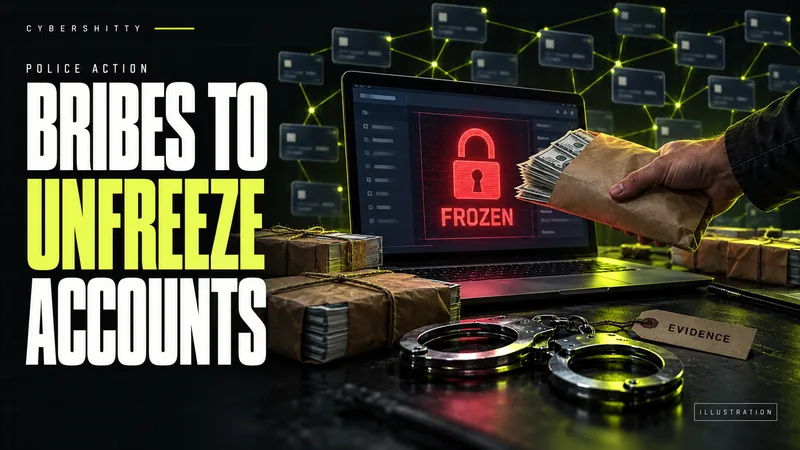
AI-generated editorial illustration by CyberShitty. Not a photograph or a document from the organisations named.
The Enforcement Directorate says a Mumbai advocate paid cash bribes through angadiyas to get frozen accounts of a cyber fraud laundering network released. The case began with a ₹2.6 crore digital arrest of a Goa resident.
01 / What happened
The Enforcement Directorate's Panaji office arrested Mumbai-based advocate Rashesh Bharatkumar Upadhyay, also known as Rashesh Shah, under the money laundering law (PMLA) at Mumbai airport on 24 October 2026, ED said on 26 October. The Special Court (PMLA), North Goa, sent him to ED custody till 29 October. He is the seventh arrest in the case.
- The original fraud: according to ED, people posing as TRAI and CBI officials kept a Goa resident under video surveillance, showed her a forged Supreme Court order and made her transfer about ₹2.6 crore into 'Secret Supervision Accounts'.
- The money trail: ED says the money moved through more than 400 mule accounts into commodity, travel and forex companies run through dummy directors by Fahim Moin Hussain Sayed and Naim Mueen Sayyed, who were arrested earlier.
- The allegation: ED says that when police froze the network's accounts on fraud complaints, the advocate got them released by paying cash bribes through angadiyas (informal cash couriers) to 'certain suspected officials of the agencies concerned'. On his own admission, ED says, he got about 100 accounts unfrozen, once paying over ₹60 lakh.
02 / Why it matters
Freezing accounts stops stolen money moving on, so victims can later get some back. ED alleges the freeze itself could be bought off. It has not yet identified the officials who took the bribes.
A frozen account only helps a victim if it stays frozen until the money is legally returned.
ED says the network's accounts appear in more than 300 victim complaints and over 160 FIRs across 20 states and union territories, with reported losses of over ₹400 crore. The bigger number in some headlines, nearly ₹28,000 crore, is the value of all banking transactions through the network (about ₹2,900 crore of it deposited in cash), not what victims lost.
03 / Confirmed vs. claimed
Confirmed (ED's releases of 26 and 19 October): the arrest and custody, the Goa FIR, the mule accounts, the turnover and cash figures, and the complaint and FIR counts. ED put losses at 'over ₹400 crore' on 26 October and 'about ₹417 crore' on 19 October. On 16 October it arrested Mukesh Kumar Pukhraj Jain, an RTGS agent for the network who, ED says, admitted knowing the money came from cyber fraud. Claimed by ED: the bribes, the 100 accounts and the ₹60 lakh payment, partly based on the advocate's own statement. These are allegations; nothing has been proven in court.
04 / What to do
- Lost money and the receiving account was frozen? Keep your 1930 acknowledgement and FIR number. Our guide on how frozen funds are released to victims explains the official routes.
- Paying cash to lift a freeze is a bribe, not a legal process. Report anyone offering to 'settle' a frozen account off the record.
- Your own account frozen over money you received unknowingly? Use the free official routes in our frozen account guide.
- A 'CBI' or 'Supreme Court' video call is a scam: see what to do on a digital arrest call. Lost money? Call 1930.
Source log / 2026-1026-ED
- Directorate of Enforcement — Press release: advocate arrested as key 'lien-fixer' for cyber fraud laundering network; 7th arrest (26 Oct 2026) Primary
- Directorate of Enforcement — Press release: arrest of Mukesh Kumar Pukhraj Jain in Goa 'Digital Arrest' case (19 Oct 2026) Primary
- Free Press Journal — ED arrests advocate at Mumbai airport in pan-India cyber fraud and 'digital arrest' case (Oct 2026) Secondary
- The Pioneer — Mumbai advocate nabbed in cyber fraud case (Oct 2026) Secondary