Guide
Fake government job letter? How to check a recruitment notice before paying a 'joining fee'
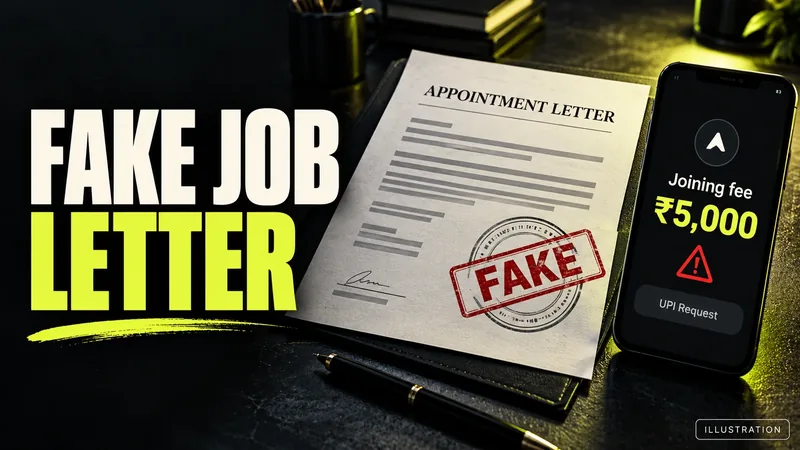
AI-generated editorial illustration by CyberShitty. Not a photograph or a document from the organisations named.
PIB Fact Check has flagged fake appointment letters in the name of the Ministry of Rural Development. How to check a letter or notice on UPSC, SSC, the department's own site and Employment News, the payment red flags, and what to do if you paid.
01 / The short answer
If an appointment letter for a government job reaches you on WhatsApp, social media or email, and someone then asks for money to confirm it, process it or 'verify' you, stop. Do not pay until you have found the same recruitment on the recruiting body's own website, or checked the request through an official channel. A letter with a logo, a seal and an employee code proves nothing on its own.
If you cannot find the recruitment on an official website, do not pay anyone for the job.
Already paid? Call 1930 now, then your bank on its official number. Section 06 has the steps.
02 / What PIB Fact Check flagged
Confirmed: on 10 September 2026, PIB Fact Check, the Press Information Bureau's fact-checking unit, said on X that multiple fake appointment letters were circulating on social media in the name of the Ministry of Rural Development. It said the letters 'are fake and have no association with the Ministry of Rural Development', and told people to beware of such fraudulent documents.
Reported: Outlook Money wrote on 15 September that the letters shown with the post are formatted as appointment and confirmation letters, with employee codes, reporting dates, duty timings, divisions, branches, postings and salary details. Some name posts such as Assistant Field Officer and Section Officer. Outlook Money also reported that PIB asked people not to forward such documents. LatestLY reported on 10 September that the letters were also spreading on messaging apps.
Neither the post nor the reports say how much money, if any, these letters asked for, or how many people received them or paid.
Reported: PIB Fact Check had warned earlier. In a post on X reported by Outlook Money on 16 August, it urged job seekers to 'Beware of Scams in the Name of Government Jobs!'. Outlook Money says the video in that post shows scammers asking for payments as medical fees, registration charges and document verification fees, and warns that a government logo or emblem does not make a recruitment post or website genuine. It quotes PIB: 'Always obtain recruitment-related information only from official sources and stay cautious of those demanding money.' We could not trace the original video, so we quote it as reported.
03 / Who says not to pay, and their exact words
You will often read 'never pay a joining fee'. Here is who says what:
- Outlook Money (15 September), in its own advice, not PIB's: if someone asks for money to confirm an appointment, process a joining letter, complete verification or secure a government job, 'treat it as a major warning sign', and do not pay without independently checking the request through an official government channel.
- National Career Service (NCS), the Ministry of Labour and Employment's job portal, says on its homepage that its services are free, that it charges no fee 'at any stage of registration, job application, interview processing and other employment related services', and that 'Jobseekers should not pay fees to employers.' It also warns that some websites and people falsely claim to be linked to NCS and use its logo.
- PIB Fact Check, as reported by Outlook Money in August: be cautious of those demanding money.
Our advice: pay nothing that is not set out in the official notice on the recruiting body's own website, and pay it only there. Never pay a person, a phone number or a link that arrived with the letter.
04 / How to check a letter or notice, step by step
- Find the recruitment notice. Outlook Money advises comparing the details in the letter, and the sender, with the recruitment notification on the official website. A letter for a job you never applied for is the first warning sign.
- UPSC posts: open upsc.gov.in yourself. Its homepage lists recruitment advertisements, notices and results, and says applications for its examinations go through its portal, upsconline.nic.in.
- SSC posts: open ssc.gov.in. Its notice board and its Apply, Admit Card, Answer Key and Result links are on the homepage. SSC's FAQ says the tentative dates of its examination notices are in its Annual Calendar of Examinations, and advises candidates to check its website regularly.
- A ministry or department: type its address yourself instead of tapping a link in the message. For the Ministry of Rural Development that is rural.gov.in. Look for the recruitment notification there.
- Employment News: the Ministry of Information and Broadcasting has published this weekly since 1976, in English and as Rozgar Samachar in Hindi and Urdu. It says it carries vacancies, exam notices and results of central and state government ministries and departments, PSUs, nationalised banks, UPSC and SSC. Look for the advertisement there. LatestLY reported that officials said MoRD recruitment is published only through government portals, national daily newspapers and Employment News, but it did not name them.
- Still unsure? Send the letter to PIB Fact Check, on WhatsApp at +91 8799711259, the number given on its portal. You can also paste the message into our scam check.
- A job abroad? The Ministry of External Affairs' eMigrate portal lists recruiting agents registered under the Emigration Act, 1983. Check the agent under 'Find Recruiting Agent'. The portal also lists unregistered agencies against which it has received grievances. Read how fake job offers end in scam compounds before you travel.
05 / Red flags in the letter or the message
- It came out of nowhere, on WhatsApp, social media or an email address not linked to the department. Outlook Money flags exactly this.
- It asks for money to process a joining letter or confirm the appointment, or as a registration, medical or document verification fee.
- It looks very official. Employee codes, reporting dates and salary figures were all in the fake MoRD letters, as reported. Detail is easy to fake; so are logos and seals.
- It asks for an OTP, Aadhaar number, bank details or a password. PIB Fact Check warned against sharing these in its earlier post, Outlook Money reported in August.
- It pushes a deadline, such as a reporting date, and ties it to a payment.
- You cannot find it on the recruiting body's website or in Employment News.
Offered money for liking videos or writing reviews instead? That is a different con: the task and part-time job scam.
06 / Already paid or sent your documents?
- Money has gone: call 1930 now, then your bank on its official number, then complete the complaint on cybercrime.gov.in. Our lost-money checklist and UPI fraud guide cover the first hour.
- Keep the evidence: the letter, the sender's number or email, the UPI ID or account you paid, and the transaction reference.
- Sent copies of your Aadhaar or PAN? Check your Aadhaar authentication history and watch for loans in your name. How to check and lock it down.
- Not paid yet, but asked to? You can look up the number or UPI ID on I4C's suspect search; a clean result is not proof it is safe. Report the message on Chakshu.
- Do not forward the letter to friends or groups, as PIB asked, according to Outlook Money. Send it to PIB Fact Check instead.
- Police will not register your case? What you can do. Ignore anyone who offers to get your money back for a fee: what recovery really looks like.
07 / Sources and limits
Confirmed (official sources): that the MoRD letters are fake, from PIB Fact Check's post of 10 September 2026, which we checked through X's embed service; NCS's no-fee statement; what the UPSC, SSC, Employment News and eMigrate websites say about themselves; PIB Fact Check's WhatsApp number, from its portal. Reported (media): what the letters contain and PIB's request not to forward them (Outlook Money, 15 September); the advice to treat any payment request as a major warning sign, which is Outlook Money's own, not PIB's; the content of PIB's earlier post and video (Outlook Money, 16 August); spread on messaging apps and the unnamed officials' statement on where MoRD recruitment is published (LatestLY, 10 September). Claimed (by the letters): that they come from the Ministry of Rural Development. PIB says they do not. Not available: what these letters asked for, and any official count of people who paid or how much they lost.
Source log / 2026-1003-YW
- PIB Fact Check on X — Fake appointment letters circulating in the name of the Ministry of Rural Development (10 Sep 2026) Primary
- National Career Service (Ministry of Labour and Employment) — Beware of Misleading Communication, homepage notice, accessed 3 Oct 2026 Primary
- Union Public Service Commission — homepage: notices, recruitment advertisements and application portal, accessed 3 Oct 2026 Primary
- Staff Selection Commission — homepage, notice board and FAQs, accessed 3 Oct 2026 Primary
- Employment News (Ministry of Information and Broadcasting) — About us, accessed 3 Oct 2026 Primary
- eMigrate (Ministry of External Affairs) — Recruiting Agents, unregistered agencies and PBSK helpline, accessed 3 Oct 2026 Primary
- PIB Fact Check portal — WhatsApp number for fact-check requests, accessed 3 Oct 2026 Primary
- Outlook Money — Got a government job appointment letter? Here's what PIB Fact Check says (15 Sep 2026) Secondary
- Outlook Money — Govt cautions job seekers against fake recruitment notices and websites (16 Aug 2026) Secondary
- LatestLY — Fake government job letters go viral: PIB Fact Check debunks appointment notices using MoRD's name (10 Sep 2026) Secondary
- Sanchar Saathi (DoT) — Chakshu: Report suspected fraud communication Primary
- National Cyber Crime Reporting Portal Primary