Guide
Fake UP/DOWN trading games: the early win, the losses and the blocked withdrawal
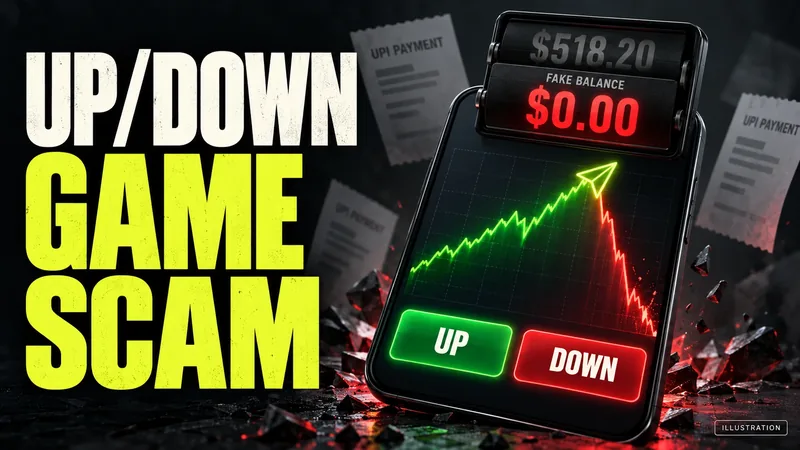
AI-generated editorial illustration by CyberShitty. Not a photograph or a document from the organisations named.
In fake 'trading games' you bet on whether a plane or a chart goes up or down. Records of related frauds show the steps: pay an agent, win a little, deposit more, lose, then face fees to withdraw. How it works, the law, and what to do if you paid.
01 / The short answer
If an app asks you to bet on whether a plane, a price or a chart will go UP or DOWN, and you top it up by paying a 'recharge agent', you are not trading. You are paying into a stranger's account, not a regulated platform.
A balance on a screen is not money in your bank.
Already paid, and now asked for a 'tax' or fee to withdraw? Do not pay it. Call 1930 and file a complaint at cybercrime.gov.in.
02 / How the trap works
No official document describes UP/DOWN games as such. These steps come from official records and reports of related frauds: a forex platform, a colour-prediction app, betting sites and a fake stock app.
- The hook. Ads and groups selling fast, easy money. The Enforcement Directorate (ED) says the Fiewin app was marketed on YouTube and Facebook as a way 'to make fast and easy money'. SEBI, the markets regulator, warns of WhatsApp and Telegram ads promising high returns.
- Pay an agent, not a platform. You may be told to 'recharge' by paying a personal UPI ID or bank account. ED says Fiewin, a colour-prediction app, took deposits into the accounts of 'recharge persons' who lent them for a commission. SEBI says legitimate platforms do not take payments into third-party accounts.
- The early win. Telangana Today reported in 2021, citing Hyderabad cybercrime officials, that colour-prediction victims first bet a small amount and 'win double the amount', which encourages them to invest more. SEBI lists the same stage in fake trading apps: 'The app shows profits'.
- The losses. ED says OctaFX, an unauthorised forex trading platform, used 'falsified candlestick charts and deliberate slippage' (trades filled at worse prices than shown), 'ensuring consistent investor losses'. Its initial investors 'received small profits to build trust', ED adds, as in a Ponzi scheme, which pays early investors with later investors' money. ED says Fiewin's games were 'based totally on luck'.
- Keep depositing. In a Nagpur gaming and betting case, ED says 'technical errors or glitches occurred' whenever the complainant neared a win, and he was 'repeatedly induced to make further deposits despite suffering repeated losses'. ED says he was cheated of about ₹58.42 crore.
- The blocked withdrawal. When colour-prediction victims try to withdraw, 'they cannot', the Telangana Today report says; CloudSEK, a cyber security firm, reported in 2022 that such wallets are 'blocked from additional withdrawals'. SEBI says blocked withdrawals come with 'excuses and fees'. In a Kolkata fake stock app case, ED says victims trying to withdraw were asked to pay more 'on account of tax'.
03 / Why the screen is not money
On a platform RBI has not authorised, no Indian exchange or regulator checks the chart or your balance. In the OctaFX case, ED says the charts were falsified. The real money moves on: ED says OctaFX layered deposits through mule accounts (bank accounts in other people's names, used to pass money on), and about ₹400 crore from Fiewin was credited to crypto wallets in the names of Chinese nationals.
04 / Already paid, or cannot withdraw?
- Stop paying. A 'tax', a withdrawal fee or one more deposit is another payment to the same people.
- Report fast. Call 1930, file at cybercrime.gov.in and tell your bank. Our UPI fraud guide covers the first hour.
- Save evidence: the app's name and link, every UPI ID and account you paid, transaction references, and chat and balance screenshots.
- Ignore recovery offers. Paying someone to 'get it back' can be a second scam. What recovery really looks like.
Be realistic. For all cyber fraud from 2023-24 to 2025-26, government figures show more than ₹56,087 crore reported and more than ₹206 crore refunded: under 1%, by our calculation. In the same period, more than ₹9,079 crore was put on hold ('marked as lien'). The system is meant 'to stop siphoning off funds by the fraudsters', the government says, so report before the money moves.
05 / How to check an app or platform
- Search the name on RBI's Alert List. But RBI says 'an entity not appearing in the list should not be assumed to be authorised'.
- Then check RBI's lists of authorised ETPs and authorised persons. Not there? Do not trade forex on it.
- Sold as stock trading? Check the broker and app with our stock tips group guide.
- Walk away from agents, personal UPI IDs, app files sent outside official app stores (APK files) and big promised returns. RBI warned in 2022 that unauthorised forex platforms advertise even in gaming apps, and that there were reports of agents promising 'disproportionate/exorbitant returns'.
- Offered a commission to receive other people's deposits in your account? Refuse. That is what Fiewin's 'recharge persons' did, ED says. See our mule accounts guide.
06 / What the law says
Forex platforms. RBI says residents may trade forex online only on RBI-authorised electronic trading platforms (ETPs) or recognised stock exchanges. Its Alert List (updated 19 November 2025) names unauthorised platforms including Binomo, IQ Option, Olymp Trade, Quotex and OctaFX. Being on the list means RBI has not authorised them; RBI does not say each one is a fraud. Residents who trade on unauthorised ETPs are 'liable for penal action under the FEMA' (the Foreign Exchange Management Act), RBI warns.
Online money games. The Promotion and Regulation of Online Gaming Act, 2025, approved by the President on 22 August 2025, bans offering, advertising and processing payments for games played 'by paying fees, depositing money or other stakes in expectation of winning', whether of skill, chance or both. Its Rules took effect on 1 May 2026, as the government's Press Information Bureau (PIB) announced, and the new Online Gaming Authority of India says in a July 2026 advisory that the Act 'has come into force on May 01, 2026'.
The Act punishes those who offer, advertise or process payments for these games. Offering one can mean up to three years in jail, a fine of up to ₹1 crore, or both. The Act sets no penalty for playing, but RBI's FEMA warning still applies on forex platforms. UP/DOWN and colour-prediction games played for money appear to fit the Act's definition on its wording, but we found no official list of banned games.
07 / Sources and limits
No official document describes UP/DOWN games as such; section 02 is assembled from related cases. Confirmed (official documents): RBI, SEBI, the Act, the Rules (PIB), the Authority's advisory and the PIB cyber fraud figures. Alleged: ED's findings in the OctaFX, Fiewin, Kolkata and Nagpur cases are claims by investigators in ongoing cases, not court verdicts. Reported: Telangana Today and CloudSEK on colour-prediction apps. The advisory we link is a scan hosted by MediaNama; we did not find it on MeitY's website. Not available: an overall official loss figure for UP/DOWN or colour-prediction games (ED gives case figures only, such as about ₹400 crore for Fiewin), or a published list of games classified under the Act.
Source log / 2026-1001-UD
- RBI — Alert List of unauthorised forex trading platforms (updated 19 Nov 2025) Primary
- RBI — RBI cautions against unauthorised forex trading platforms, PR 2021-2022/1660 (3 Feb 2022) Primary
- RBI — List of authorised Electronic Trading Platforms (ETPs) Primary
- RBI — Foreign Exchange Management page (lists of authorised persons) Primary
- Enforcement Directorate — OctaFX: crypto worth about Rs 2,385 crore attached (17 Oct 2025) Primary
- Enforcement Directorate — Supplementary prosecution complaint in Fiewin gaming app case (19 Dec 2025) Primary
- Enforcement Directorate — Searches in online investment fraud case, Kolkata (15 Jun 2026) Primary
- Enforcement Directorate — Searches in illegal online gaming and betting fraud case, Nagpur (21 Aug 2026) Primary
- SEBI Investor — Beware of fake trading app scams (undated poster, accessed 1 Oct 2026) Primary
- Telangana Today — Don't fall for 'colourful' bait: Cybercrime officials (15 Dec 2021) Secondary
- CloudSEK — Social Media Nexus Spreads Color Prediction Games that Defraud Users (28 Jul 2022) Secondary
- MeitY — The Promotion and Regulation of Online Gaming Act, 2025 (Act No. 32 of 2025, Gazette of 22 Aug 2025) Primary
- PIB — Promotion and Regulation of Online Gaming Rules, 2026 (22 Apr 2026) Primary
- Online Gaming Authority of India (MeitY) — Advisory on sections 5, 6 and 7 of the PROG Act (29 Jul 2026; scanned copy hosted by MediaNama) Primary
- PIB — National cybercrime response mechanism: NCRP and CFCFRMS figures (22 Jul 2026) Primary
- National Cyber Crime Reporting Portal Primary