Guide
UPI charges from 15 October: what changes for you, and how to spot fake 'UPI fee' messages
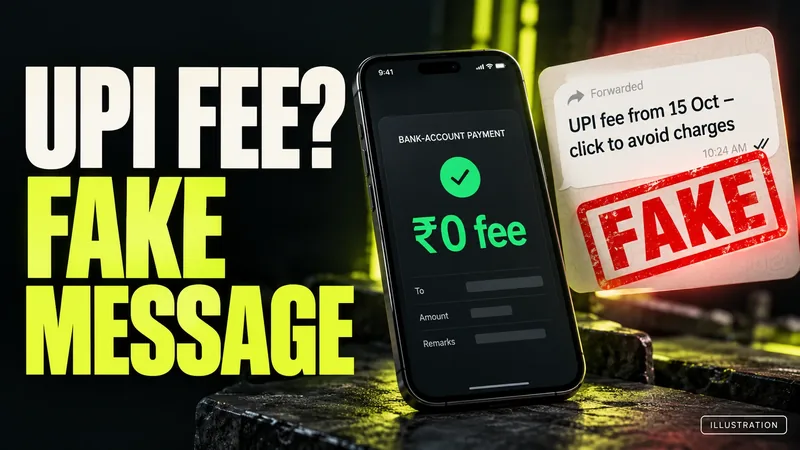
AI-generated editorial illustration by CyberShitty. Not a photograph or a document from the organisations named.
From 15 October, some shops pay a 0.4% fee on UPI payments above ₹2,000. Customers do not: transfers to people stay free at any amount, and banks have been advised to make sure merchants do not pass the fee on. Also: how to spot fake 'UPI fee' messages.
01 / The short answer
If you send money to a person on UPI, or pay a shop ₹2,000 or less, nothing changes for you on 15 October 2026. The new 0.4% charge, called the merchant discount rate (MDR), applies only to certain shop payments above ₹2,000, and the Finance Ministry says it is not a charge on customers.
The new UPI charge is the shop's cost, not yours, and there is nothing you need to do to keep UPI free.
A message asking you to click a link, register, pay or enter your UPI PIN to 'stay free' is not part of the rules. Already did it? Call your bank on its official number now. If money has gone, call 1930. Section 08 has the steps.
02 / What the rules say, and who pays
Confirmed by the Ministry of Finance in a release of 15 September 2026:
- Transfers to people stay free, whatever the amount. 'No transaction fee, platform fee or other charge may be imposed on individuals for sending or receiving money through UPI.'
- Shop payments up to ₹2,000 stay free, and so do all payments to small merchants, such as street vendors, who receive up to ₹1 lakh a month through UPI QR codes (a category called P2PM).
- Above ₹2,000, some merchants pay 0.4%, capped at ₹300 for payments of ₹75,000 and above. Essential sectors, including railways, telecom, insurance, fuel and agricultural inputs, pay a flat ₹5. Capital-market payments (mutual funds, securities, stockbrokers and dealers) carry 0.02%, capped at ₹300. The Ministry says about 96% of merchant transactions are unaffected.
- Customers do not pay. MDR 'is not a charge on customers making UPI payments'. Banks have been advised to ensure that merchants do not pass it on, and UPI apps are 'expressly prohibited from imposing platform fees or hidden charges'.
- No limit on free use. There are no monthly quotas, volume restrictions or tiered caps. Daily limits, generally ₹1 lakh to ₹5 lakh, are security limits, 'not charging thresholds'.
By our calculation, on a ₹5,000 bill at a shop that pays MDR, 0.4% is ₹20. The shop pays it; your bill stays ₹5,000. MDR is 'neither a tax nor a charge collected by the Government or NPCI' (the National Payments Corporation of India), the Ministry says. NPCI's own FAQ adds that merchants may not pass it on and customers pay only the listed price, SCC Online reported.
03 / The start date, and the Supreme Court case
As of 1 October 2026. The Hindu reported on 15 September that, under NPCI's circular, the new structure takes effect from 15 October 2026, and SCC Online reported that NPCI's FAQ gives the same date. PIB Fact Check, the government's fact-checking unit, also refers to 'the UPI fee roll-out on 15 October' in its post of 23 September (more in section 04). The Finance Ministry's 15 September release itself gives no date. On 16 September, Business Today, citing the news agency PTI, reported that government sources had ruled out a rollback.
On 28 September, a three-judge Supreme Court bench headed by Chief Justice Surya Kant refused an interim stay on a public interest petition against the fee, The Hindu and The Indian Express reported. It issued notice to the Union government, RBI (the Reserve Bank of India) and NPCI, and gave them four weeks to reply. One judge asked the government to explain in an affidavit what the charge is, if it is not a tax or a fee, The Hindu reported. The case is pending, so we will update this page if anything changes.
04 / Fake 'UPI fee' messages: what to watch for
We found no police or bank warning yet about scams that use the new charge as bait. But rumours are spreading. On 23 September, PIB Fact Check, the government's fact-checking unit, said a newspaper clipping's headline claiming that banks had been asked to stock up ATMs ahead of the UPI fee rollout was fake; RBI and the Finance Ministry had issued no such instructions. Outlook Money reported that the clipping was circulating online. In August, the Ministry asked people to rely only on official information from the Ministry, RBI and NPCI, and 'not to forward unverified messages'.
As a precaution, treat these as warning signs:
- A link for a 'UPI fee waiver', to 'reactivate UPI' or to 'avoid charges'. There is no fee on you to waive.
- A call or message asking you to 'register', verify or update KYC to keep UPI free, or to pay ₹1 or a 'registration fee'.
- A request for your UPI PIN, or to approve a payment request or AutoPay. Entering your PIN sends money; you never need it to receive money. How these tricks work.
- An app to install, or a request to share your screen.
- A forward announcing charges on every payment, a monthly free quota or a deadline to act.
To check, open your UPI or bank app yourself, never through the message. Paste the text into our scam check, or see how to check a link or UPI ID. Practise on two fictional Scam Lab demos: a 'refund' that sends money and a ₹1 AutoPay trap.
05 / If a shop adds a 'UPI fee'
Under these rules, a separate 'UPI fee' on your bill has no basis. Bills of ₹2,000 or less carry no MDR at all. Above that, MDR is the shop's cost, and banks have been advised to make sure merchants do not pass it on.
Point this out, ask for the bill without the extra charge, and pay another way or shop elsewhere if the shop insists. Keep the bill, or a photo of any notice about the fee. Where to complain: as of 1 October 2026, we have found no official NPCI, RBI or government page that says where to report a shop that adds a UPI fee. We will add one when it is published. Until then, the general route for consumer disputes, such as an overcharge, is the National Consumer Helpline: call 1915 or go to consumerhelpline.gov.in. It is not a route set up for the UPI fee. Shopping big this festive season? See our festive sale guide.
06 / Questions people ask
Will I pay a charge on UPI from 15 October? No, the Finance Ministry says. MDR is not a charge on customers, and UPI apps may not add platform fees.
Is sending money to family still free? Yes, at any amount, for both the sender and the receiver.
Is there a monthly limit on free UPI payments? No. The Ministry says there are no monthly quotas.
Did the Supreme Court stop the charge? No. It refused an interim stay on 28 September, as reported. The case is pending.
Is the 0.4% a tax? The Ministry says MDR is neither a tax nor a charge collected by the government or NPCI.
I got a 'UPI fee waiver' message. Is it real? Treat it as a scam: there is no fee on you to waive. Report it on Chakshu.
07 / Confirmed, reported and claimed
Confirmed (official documents): the rates, exemptions and figures, from the Finance Ministry's release of 15 September 2026 on PIB; that customers do not pay MDR, from that release and the one of 8 August 2026; the 15 October roll-out date and the ATM clipping debunk, from PIB Fact Check's post of 23 September. Reported (media): that NPCI's circular sets the 15 October start (The Hindu); NPCI's FAQ on the date and the listed price (SCC Online); no rollback (Business Today, citing PTI); the 28 September hearing (The Hindu, The Indian Express); the clipping's spread (Outlook Money). NPCI's website blocked our link checks, so we cite its documents as reported. As of 1 October 2026, a photo caption on the Indian Express report says the court 'has stayed' the fee; the report itself says the court refused a stay. Claimed (and denied): that ordinary users will be charged (on 8 August the Finance Ministry said some people were misreading an amendment to the payments law this way); and that banks were told to stock up ATMs (a newspaper headline that PIB Fact Check called fake). Not available: a police or bank report of frauds using the new charge, such as messages telling you to register, pay or 'reactivate' UPI to keep it free (section 04 lists these only as warning signs), and an official complaint route made for a shop's UPI fee.
08 / Tricked by a 'UPI fee' message? What to do now
- Money has gone: call 1930 now, then your bank on its official number, then complete the complaint on cybercrime.gov.in. Our lost-money checklist and UPI fraud guide cover the first hour.
- Shared your UPI PIN, an OTP or card details, but no money has gone: call your bank on the number in its official app or website, or on your card, and block UPI, cards and net banking. Change your UPI PIN and passwords. If money leaves later, call 1930 at once.
- Approved an AutoPay request: tell your bank at once, and cancel any UPI AutoPay or mandate you set up.
- Installed an app or shared your screen: switch on flight mode, uninstall the app and call your bank. Change PINs and passwords from a different, trusted device. How APK malware works.
- Your bank has not resolved your written complaint within 30 days, or you are unhappy with its reply? Go to the RBI Ombudsman.
- Lost nothing? Report the call or message on Chakshu, on the government's Sanchar Saathi portal. How to report.
- Ignore anyone who offers to 'recover' your money for a fee: what recovery really looks like.
Source log / 2026-1001-UF
- PIB (Ministry of Finance) — UPI continues to remain free for peer to peer transactions and 96% of merchant transactions (15 Sep 2026) Primary
- PIB (Ministry of Finance) — No charges for UPI users (8 Aug 2026) Primary
- PIB Fact Check on X — Claim that banks were asked to stock up ATMs ahead of UPI fee rollout is fake (23 Sep 2026) Primary
- The Hindu — Merchants to be charged 0.4% for UPI transactions over ₹2,000; small vendors exempt (15 Sep 2026) Secondary
- SCC Online — UPI MDR explained: No charges for consumers, 0.4% fee on select merchant transactions above ₹2,000 (on NPCI's FAQ of 15 Sep 2026; 16 Sep 2026) Secondary
- Business Today (with PTI) — UPI MDR: No rollback of 0.4% fee above Rs 2,000; govt says move will make UPI self-sustainable (16 Sep 2026) Secondary
- The Hindu — If neither a tax nor fee, what is this 'expropriation', SC asks govt. on UPI merchant discount rate (28 Sep 2026) Secondary
- The Indian Express — Supreme Court refuses to stay MDR fee on UPI: What it means for customers, changes after Oct 15 (28 Sep 2026) Secondary
- Outlook Money — Banks told to stock up ATMs ahead of UPI charges? PIB quashes news as fake (24 Sep 2026) Secondary
- Sanchar Saathi (DoT) — Chakshu: Report suspected fraud communication Primary
- National Cyber Crime Reporting Portal Primary
- Department of Consumer Affairs — National Consumer Helpline (official portal) Primary