Guide
Navratri garba: fake passes, 'rent a garba partner' ads police flagged, and pay-first links
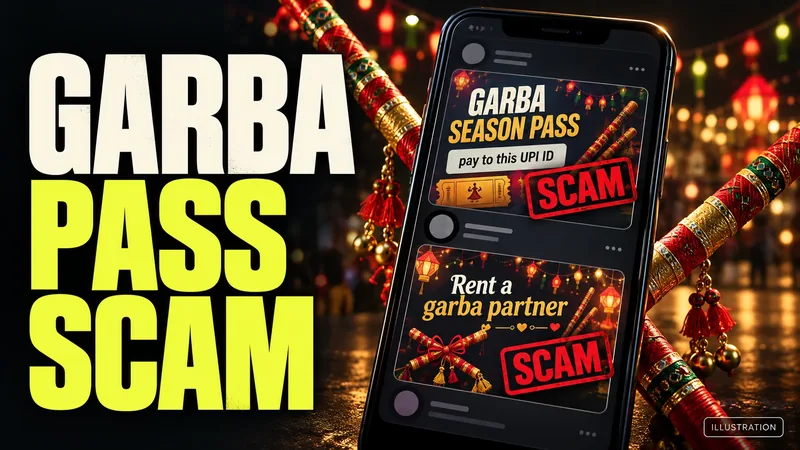
AI-generated editorial illustration by CyberShitty. Not a photograph or a document from the organisations named.
Navratri runs from 11 to 20 October. Mumbai police arrested people over fake garba passes in 2023 and 2024, and Ahmedabad's cyber crime cell has warned about 'rent a garba partner' ads. How to buy a pass safely, and what to do if you paid.
01 / The short answer
Sharad Navratri 2026 runs from Sunday, 11 October to Vijayadashami (Dussehra) on Tuesday, 20 October. Scammers work to the same calendar. Expect three lures: cheap passes from someone who is not the organiser, 'rent a garba partner' ads, and links that ask you to pay before you can check anything.
Buy your pass from the organiser, never from a stranger's UPI ID.
Already paid, or clicked a link? Call 1930. Being threatened after a chat or a video call? Do not pay, and follow our sextortion guide. Section 06 has the steps.
02 / Fake passes: what police found in Mumbai
Reported by the media from police accounts. These are allegations, not court findings.
- October 2023, Borivali. Police arrested four people over fake Navratri passes. The Indian Express reported fakes for one popular event; IANS said the organisers of two shows were cheated. The Express reported that real passes cost ₹3,000 to ₹3,800 and the fakes sold for about ₹2,600. Police seized 1,000 fake passes and said the gang planned to make about ₹30 lakh. IANS put the racket at more than ₹30 lakh and said over 1,000 people were allegedly sold fake ₹3,000 'season passes'. The two reports do not match, so treat the figures as estimates.
- How it came out. Some buyers took their passes to the organiser's authorised stall to check them. They were fake, the Express reported.
- October 2024, Borivali. Police arrested six people over fakes for another garba event, The Times of India reported. Police said at least 600 fakes were made and 450 sold, cheating the organisers of ₹6 lakh. Real passes cost ₹1,000 on an online booking portal; Lokmat Times reported that the fakes went for ₹300 to ₹500, and the event manager told TOI they were sold at ₹400 each. Visitors found out at the gate, when the QR codes on their passes would not scan.
- According to TOI, four fake garba pass scams were reported in North Mumbai during Navratri 2023, and 11 people were arrested.
The pattern: a pass cheaper than the official price, from someone other than the organiser, that is caught only when it reaches the organiser's stall or gate. The event manager told TOI that visitors should buy only from the event's verified online booking portal.
03 / 'Rent a garba partner' ads
In September 2026, posts and reels on Instagram and Facebook offered a 'partner' to play garba with, for two hours or a whole night, with matching outfits, photos and reels, Gujarat Samachar reported. IANS cited reports of packages from about ₹500 to ₹6,500; Gujarat Samachar reported ₹1,000 to ₹10,000, in Silver, Gold and Platinum tiers.
Reported: Ahmedabad's Cyber Crime Cell began examining the posts in September. DCP Lavina Sinha told IANS that:
- the person behind a post is not necessarily someone you know;
- a post can be a way to start a chat that is later misused;
- you may pay and never get the service;
- the payment link itself can be used for cyber fraud.
Gujarat Samachar reported that she described such ads as a form of cybercrime, and that the cell warned of honeytraps and financial extortion. It also warned of APK files (Android apps sent outside the official app store) or links sent as the partner's 'details', which could let fraudsters hack a phone and steal money. IANS reported that police were still working out whether the posts were genuine services or fronts for fraud.
Unverified claim: Gujarat Samachar, citing a source it did not name, reported that several young people in Gujarat had already lost lakhs of rupees to such posts. It also reported that police had leads on a gang allegedly running the fraud. Neither report gives a police figure for complaints or losses.
04 / Pay-first links: the common thread
All three lures end the same way: you pay before you can check anything. Walk away if you see any of these:
- The seller takes payment only by UPI to a personal ID, by a QR code sent in a chat, or through a 'booking link' in a direct message.
- The pass is cheaper than the organiser's price, or there are 'only a few left' and you must pay now.
- You are asked to install an app or open a file to receive your pass or see your partner's 'details'.
- A 'partner' pushes for a private chat or a video call before anything is agreed. That is how the scam in our sextortion guide often starts.
CERT-In, the national cyber security agency, advises in an official advisory: don't click links or attachments from unknown senders; type the organisation's address yourself; install apps only from official app stores; and check the banking name before you pay by QR code. Before paying anyone, you can also look up their number, UPI ID or profile on I4C's suspect search. A clean result does not prove a seller is honest.
Practise on a fictional example in our Scam Lab: the impossible-sale demo.
05 / How to buy a pass safely
- Buy from the organiser: at its own counter, or on the booking platform it names on its official pages. Both Mumbai cases came to light at the organiser's end: one at its stall, the other at its gate.
- Never pay a personal UPI ID for a 'season pass'. If your UPI app shows a person's name instead of the organiser's or the platform's, stop.
- Got a pass from someone else? Ask the organiser's counter to check it before the night, as the buyers in the 2023 Borivali case did.
- Keep proof: the receipt or booking ID, and the seller's number, profile and UPI ID.
- No app needed. Do not install an app or open an APK file to 'receive' a pass. How APK malware works.
- Shopping for the festival too? See our festive sale scams guide.
06 / What to do if you were tricked
- Paid for a pass or a 'partner' that never came, or paid through a link: call 1930 now, then your bank on its official number (bank fraud helplines), then complete the complaint on cybercrime.gov.in. Our lost-money checklist and UPI fraud guide cover the first hour.
- Clicked a link or installed an app: switch on flight mode, uninstall the app and call your bank to block cards, UPI and net banking. Change PINs and passwords from a different, trusted device. If you think your phone has been hacked, DCP Sinha's advice, as reported by IANS, is to contact 1930 and inform the nearest police station.
- Being blackmailed after a chat or a video call: do not pay, stop replying, save screenshots of the profile, chats and any UPI IDs, then report and block. Our sextortion guide covers reporting and getting content taken down. See also how the scam works, and practise with the Scam Lab demo.
- Bought a fake pass in person: tell the organiser, and file a complaint at your local police station with the pass and whatever you know about the seller.
- No money lost: if the contact came by call, SMS or WhatsApp, report it on Chakshu, on the government's Sanchar Saathi portal, within 30 days (how to report). Report Instagram or Facebook profiles and posts through 'Report Suspect' on cybercrime.gov.in and inside the app.
- Ignore anyone who offers to 'recover' your money for a fee: what recovery really looks like.
07 / Sources and limits
Confirmed (official documents): Dussehra on Tuesday, 20 October 2026 (the central government's holiday list, DoPT); CERT-In's advice; Chakshu's 30-day window; the suspect search and 'Report Suspect' facilities on cybercrime.gov.in. Dates from Drik Panchang (a panchang publisher, not an official source): Navratri from Sunday, 11 October to Tuesday, 20 October 2026, in its New Delhi calendar. Reported (media): the Ahmedabad warning (IANS, 21 September 2026; Gujarat Samachar, 22 September 2026); the 2023 Borivali case (IANS via Siasat; The Indian Express) and the 2024 case (The Times of India; Lokmat Times). The arrests are police allegations, not convictions. The outlets differ on some figures and on which events were hit: IANS says two shows were cheated in 2023 where the Express names one, and TOI and Lokmat name the 2024 event differently. So we do not name the events in the text. Claimed: by the ads and sellers, that a pass or a 'partner' comes once you pay; and by an unnamed source quoted in Gujarat Samachar, that several young people in Gujarat have already lost lakhs of rupees to such posts. That loss claim is unverified, and IANS described the posts as still under examination. Not available: an official count of garba-related fraud complaints or losses, or a confirmed case of anyone losing money to the 2026 'rent a partner' ads. We also found no reports of fake-pass arrests in 2025 or 2026.
Source log / 2026-1001-NG
- DoPT — Holidays to be observed in Central Government Offices during the year 2026, O.M. F.No.12/2/2023-JCA (3 Jul 2025) Primary
- CERT-In — Advisory CIAD-2024-0050: Preventing Online scams (24 Oct 2024) Primary
- National Cyber Crime Reporting Portal (MHA) — Report & Check Suspect, accessed 1 Oct 2026 Primary
- Sanchar Saathi (DoT) — Chakshu: Report suspected fraud communication Primary
- Social News XYZ (IANS) — Gujarat Police examines viral 'rent a garba partner' posts ahead of Navratri (21 Sep 2026) Secondary
- Gujarat Samachar — Ahmedabad Cyber Crime Cell issues warning after 'rent-a-partner' garba posts go viral ahead of Navratri (22 Sep 2026) Secondary
- The Indian Express — Inspired by 'Farzi' web series, Mumbai man prints 'passes' worth Rs 30 lakh for popular garba event; held along with 3 others (16 Oct 2023) Secondary
- Siasat (IANS) — Mumbai police bust Rs 30 lakh fake Navratri ticket scam (16 Oct 2023) Secondary
- The Times of India — Youth gang arrested for selling counterfeit passes to popular Borivli garba event (8 Oct 2024) Secondary
- Lokmat Times — Mumbai: Borivali Police bust fake pass scam for RangaRaj Garba Dandiya event; six arrested (9 Oct 2024) Secondary
- Drik Panchang — 2026 Shardiya Navratri Calendar, New Delhi (accessed 1 Oct 2026) Secondary